
Passive Fire Protection Surveys
Comprehensive structural audits to identify and rectify gaps in your building’s internal fire-stopping and compartmentation systems.
Service Overview
At Greensurv, we believe that the most effective fire safety is built into the fabric of the building itself. Passive Fire Protection (PFP) refers to the integral components of a structure that are designed to contain a fire at its origin and prevent the spread of heat and smoke. Over time, building renovations, cable installations, and plumbing works often breach these vital fire-rated walls and floors, leaving "hidden" gaps that allow fire to bypass safety doors. Our expert PFP Surveys involve a meticulous, often intrusive, inspection of your building’s voids, risers, and ceiling cavities. We identify every breach in your fire compartmentation and provide a detailed technical register of where fire-stopping is missing or compromised, ensuring your property remains a series of safe, life-saving compartments.
Compartmentation & Structural Integrity Audit
The primary goal of a PFP survey is to verify that fire-rated walls, floors, and ceilings are continuous and haven't been compromised by age or poor workmanship. We inspect the "hidden" areas of your building to ensure that fire cannot travel through voids.
.
Checking the fire-resistance rating of internal walls and identifying non-compliant materials.
Looking above suspended ceilings and under floorboards for unsealed breaches.
Assessing if steel beams are correctly coated with intumescent paint or fire boarding.
Inspecting vertical shafts where utilities travel to ensure they are correctly fire-stopped at every level.
Verifying that the physical building layout matches the original fire safety design strategy.
Penetration Sealing & Fire-Stopping Review
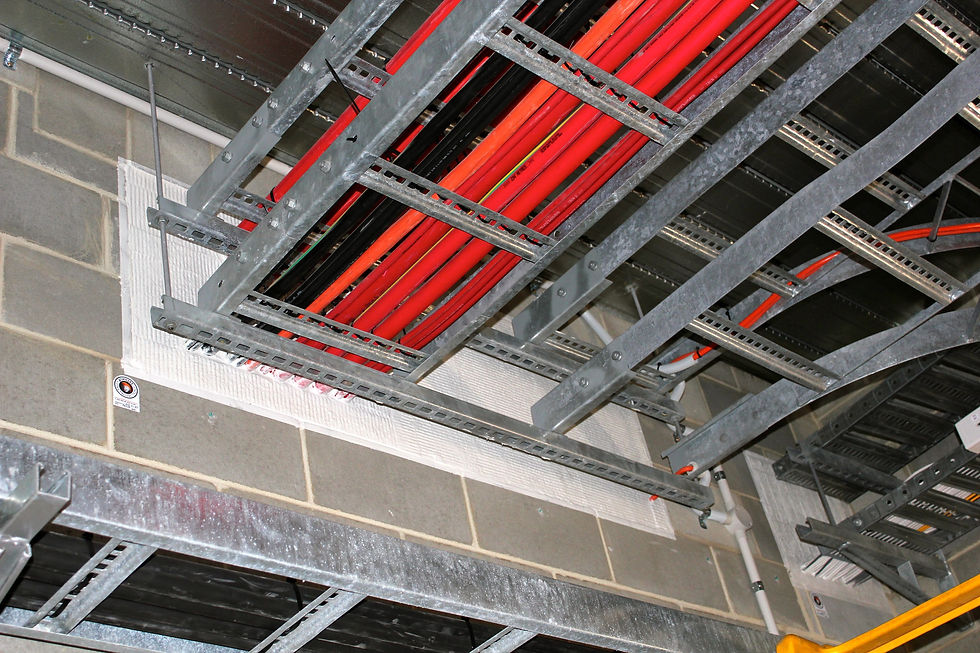
Wherever a pipe, cable, or duct passes through a fire-rated wall, it creates a potential "fire bridge." Our survey focuses on these penetration points to ensure they are sealed with certified, fire-resistant materials that expand under heat.
Identifying gaps around electrical conduits and plumbing that lack proper fire-stopping.
Verifying that dampers within ventilation ductwork will trigger correctly to block smoke.
Checking the condition of seals around letterboxes, air bricks, and service hatches.
Auditing the joints between walls and floors to ensure they are smoke-tight.
Ensuring that previously installed fire-stopping products (mastic, pillows, or batts) are still fit for purpose.
Key Benefits
Containment of Fire
Effective PFP limits fire to a single room or "compartment," providing more time for evacuation and reducing total property damage.
Regulatory Compliance
Meet your legal obligations under the Regulatory Reform (Fire Safety) Order 2005 and the Building Safety Act 2022.
Enhanced Life Safety
By blocking the path of toxic "cool smoke," PFP prevents the leading cause of death in building fires.
Risk Reduction for Insurers
A professional PFP survey from Greensurv provides insurers with documented proof that your building’s fire risks are being managed.
Our Process
STEP 01
Scoping & Documentation Review
We study your building's original fire strategy and floor plans to identify the designated fire-rated compartments.
STEP 02
Non-Destructive & Intrusive Survey
Our Greensurv surveyors use borescope cameras and physical inspections to check hidden voids and service penetrations.
STEP 03
Detailed Defect Mapping
Every breach is logged with a unique ID, high-resolution photograph, and exact location on your building's floor plans.
STEP 04
Remedial Action Report
You receive a prioritized "Traffic Light" report (Red/Amber/Green) outlining the necessary fire-stopping repairs to restore compartmentation.
Frequently Asked Questions
What is the difference between active and passive fire protection?
Active protection (like sprinklers or alarms) requires an action to work. Passive protection (like fire walls) is "always on" and works by physically blocking the fire's path.
Why do I need a PFP survey if I already have a Fire Risk Assessment (FRA)?
A standard FRA is often a visual, non-intrusive check. A PFP Survey goes deeper into the "fabric" of the building, looking into ceiling voids and risers that an FRA might miss.
Does the survey involve breaking walls?
We use non-destructive methods like borescope cameras wherever possible. If we suspect a major hidden breach, we will discuss "intrusive" checks with you first.
How often should a compartmentation survey be carried out?
It is recommended every 3 to 5 years, or immediately after any major electrical, plumbing, or structural renovation work.
Can Greensurv fix the gaps found in the survey?
At Greensurv, we focus on providing an independent, unbiased audit. We can provide you with a technical specification that you can give to a certified fire-stopping contractor for repairs.